

Provably fair technology has revolutionized the online gaming industry by introducing unprecedented transparency and trust. This cryptographic innovation allows players to independently verify that every game round is genuinely random and hasn't been manipulated by operators.
Unlike traditional online games where players must trust the house's word, provably fair systems provide mathematical proof of fairness. This technology has become the gold standard for reputable mini-game platforms, ensuring that crash games, dice rolls, and other instant-win games operate with complete integrity.
The Foundation of Provably Fair Gaming
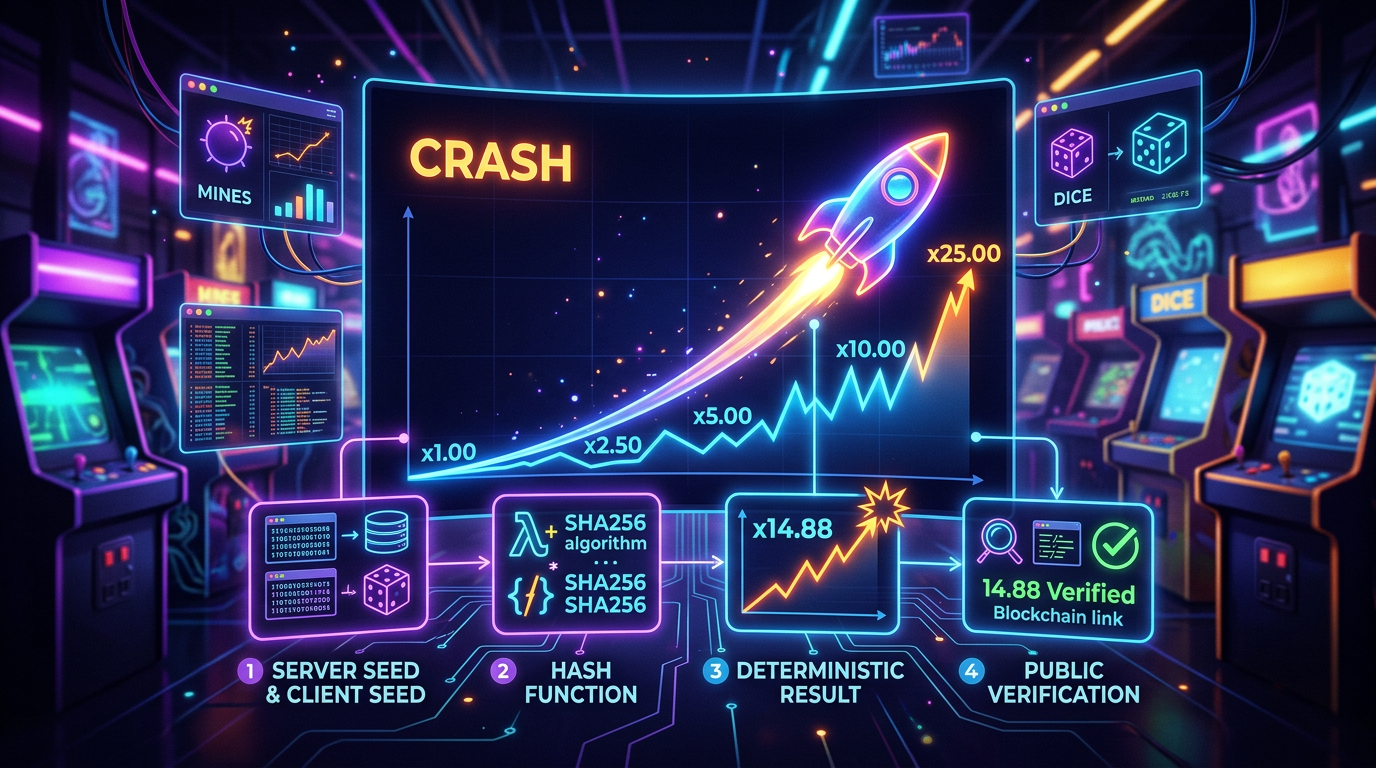
Provably fair technology relies on cryptographic hash functions and predetermined seeds to generate random outcomes. The system works by creating a chain of verifiable data that players can audit at any time.
At its core, the technology uses three key components: a server seed (controlled by the operator), a client seed (influenced by the player), and a nonce (a counter that increments with each bet). These elements combine to create unique, unpredictable results for every game round.
The beauty of this system lies in its transparency. Before any game begins, operators commit to their server seed by publishing its hash. This cryptographic commitment prevents them from changing the seed after seeing player actions or bets.
Step-by-Step Breakdown of Crash Game Verification
Crash games serve as an excellent example of provably fair implementation. These popular mini-games feature a multiplier that increases until it "crashes" at a predetermined point, and players must cash out before the crash occurs.
Pre-Game Setup
Before each crash round begins, the server generates a random seed and immediately creates its SHA-256 hash. This hash gets displayed to players before any betting starts, creating an immutable commitment to the game's outcome.
Players can then input their own client seed or use an automatically generated one. This client seed adds an extra layer of randomness and gives players partial control over the outcome generation process.
The Crash Point Calculation
The crash multiplier calculation typically follows this process:
- The server seed, client seed, and nonce combine to create a unique string
- This string undergoes SHA-256 hashing to produce a hexadecimal output
- The first 8 characters of this hash convert to a decimal number
- A mathematical formula transforms this number into the crash multiplier
Most crash games use the formula: 99 / (1 - (hex_value / 16^8)) * house_edge. This ensures the crash point follows a specific distribution while maintaining the house edge.
Real-Time Verification Process
During each crash round, players can verify the outcome using the following steps:
First, obtain the server seed hash (displayed before the game), your client seed, and the current nonce. These three pieces of information should be accessible through the game interface or your betting history.
Next, combine these values in the specified format (usually server_seed:client_seed:nonce) and apply the SHA-256 hash function. Many online tools can perform this calculation, or you can use the verification script provided by the gaming platform.
Finally, convert the resulting hash using the platform's specific algorithm to determine the crash multiplier. This calculated result should match exactly with the actual crash point from the game.
Advanced Verification Techniques
Beyond basic hash verification, sophisticated players employ additional techniques to ensure fairness. These methods provide deeper insights into the randomness quality and distribution of outcomes.
Seed Rotation Analysis
Reputable platforms rotate server seeds regularly, typically every 24 hours or after a predetermined number of bets. Players should monitor this rotation to ensure seeds aren't being reused or manipulated.
When seeds rotate, operators must reveal the previous server seed in plaintext. This revelation allows players to verify all previous games using that seed and confirms that the original hash commitment was legitimate.
Statistical Distribution Testing
Advanced verification involves analyzing large datasets of game outcomes to check for proper statistical distribution. Crash multipliers should follow expected probability curves, with lower multipliers occurring more frequently than higher ones.
Players can export their betting history and perform chi-square tests or other statistical analyses to verify that outcomes match theoretical distributions. Significant deviations might indicate problems with the random number generation process.
Common Verification Tools and Methods
Several tools make provably fair verification accessible to all players, regardless of technical expertise. These resources range from simple online calculators to comprehensive audit scripts.
Browser-Based Verifiers
Many gaming platforms provide built-in verification tools directly in the browser. These tools typically require players to input their server seed, client seed, and nonce to instantly calculate expected outcomes.
Third-party verification websites offer independent validation services. These platforms aren't affiliated with gaming operators and provide unbiased verification of provably fair algorithms.
Open-Source Scripts
Developers have created numerous open-source verification scripts in various programming languages. These scripts allow technically savvy players to audit games independently and even modify verification methods for custom analysis.
GitHub repositories contain collections of provably fair verification tools for different gaming platforms. These resources enable players to verify outcomes offline and maintain complete control over the verification process.
For more insights, check out our guide on World Cup 2026 Betting Surge – How to Enjoy the Tournament Without Losing Control.
Understanding risk management strategies becomes crucial when applying provably fair verification to your gaming approach. Similar to how Plinko Strategy Guide – Risk Levels, Row Settings, and Bankroll Tips for Every Player Type emphasizes the importance of systematic approaches to mini-games, proper verification techniques should be part of every player's toolkit for responsible gaming.
Red Flags and Warning Signs
Despite the robustness of provably fair technology, players should remain vigilant for potential issues or manipulative practices by unscrupulous operators.
Implementation Problems
Some platforms claim to use provably fair technology but implement it incorrectly. Common issues include using weak hash functions, predictable seed generation, or flawed outcome calculation formulas.
Players should verify that platforms use industry-standard SHA-256 hashing and follow established provably fair protocols. Any deviation from these standards should raise immediate red flags.
Transparency Issues
Legitimate provably fair systems provide complete transparency about their algorithms and verification methods. Operators should publish detailed explanations of their implementation and provide all necessary data for verification.
Warning signs include platforms that hide verification details, refuse to provide server seeds after rotation, or make verification unnecessarily complicated. These practices suggest potential manipulation or poor implementation.
The Future of Provably Fair Gaming
Provably fair technology continues evolving with new developments in cryptography and blockchain technology. These advances promise even greater transparency and security for online gaming.
Blockchain-based implementations offer immutable records of all game outcomes and verification data. Smart contracts can automate the verification process and eliminate any possibility of operator interference.
Zero-knowledge proofs represent another frontier in provably fair gaming. These cryptographic techniques allow operators to prove fairness without revealing sensitive information that could compromise future games.
Practical Tips for Players
Successfully implementing provably fair verification requires consistent habits and attention to detail. Players should develop systematic approaches to checking game outcomes and maintaining verification records.
Always verify a sample of your games, particularly those with significant wins or losses. While checking every single bet might be impractical, regular spot-checking ensures ongoing fairness and builds confidence in the platform.
Keep detailed records of your verification activities, including server seeds, client seeds, and calculation results. These records serve as evidence of fair play and help identify any patterns or irregularities over time.
Stay informed about provably fair standards and best practices within the gaming community. Forums, social media groups, and technical documentation provide valuable resources for improving your verification skills.
Frequently Asked Questions
What makes a game provably fair?
A provably fair game uses cryptographic methods to prove that outcomes are genuinely random and haven't been manipulated. The system relies on predetermined server seeds, player-influenced client seeds, and transparent algorithms that players can independently verify. All components must be publicly auditable for the game to be truly provably fair.
How often should I verify my game results?
While you don't need to verify every single bet, it's recommended to check a representative sample of your games regularly. Focus on verifying significant wins, losses, or any outcomes that seem suspicious. Many experienced players verify 10-20% of their games or perform weekly spot-checks to maintain confidence in the platform's fairness.
Can provably fair technology be manipulated?
Properly implemented provably fair systems are extremely difficult to manipulate due to their cryptographic nature. However, weak implementations, poor seed generation, or flawed algorithms can create vulnerabilities. This is why it's crucial to use platforms that follow established provably fair standards and provide complete transparency about their methods.
What should I do if verification reveals unfair results?
If your verification shows that game outcomes don't match the expected results, first double-check your calculations and ensure you're using the correct algorithm. If discrepancies persist, document the evidence and contact the platform's customer support immediately. Reputable operators will investigate promptly and provide explanations or corrections if necessary.
Do all mini-games use the same provably fair algorithm?
No, different types of mini-games often use variations of provably fair algorithms optimized for their specific mechanics. Crash games, dice games, and Plinko may use different mathematical formulas to generate outcomes, but they all rely on the same fundamental principles of cryptographic hashing and seed-based randomness.
Is provably fair verification too technical for average players?
While the underlying cryptography is complex, modern platforms provide user-friendly verification tools that require no technical expertise. Most verification can be done through simple web interfaces or automated tools. Understanding the basic concepts helps build confidence, but you don't need to be a cryptography expert to effectively verify game fairness.