
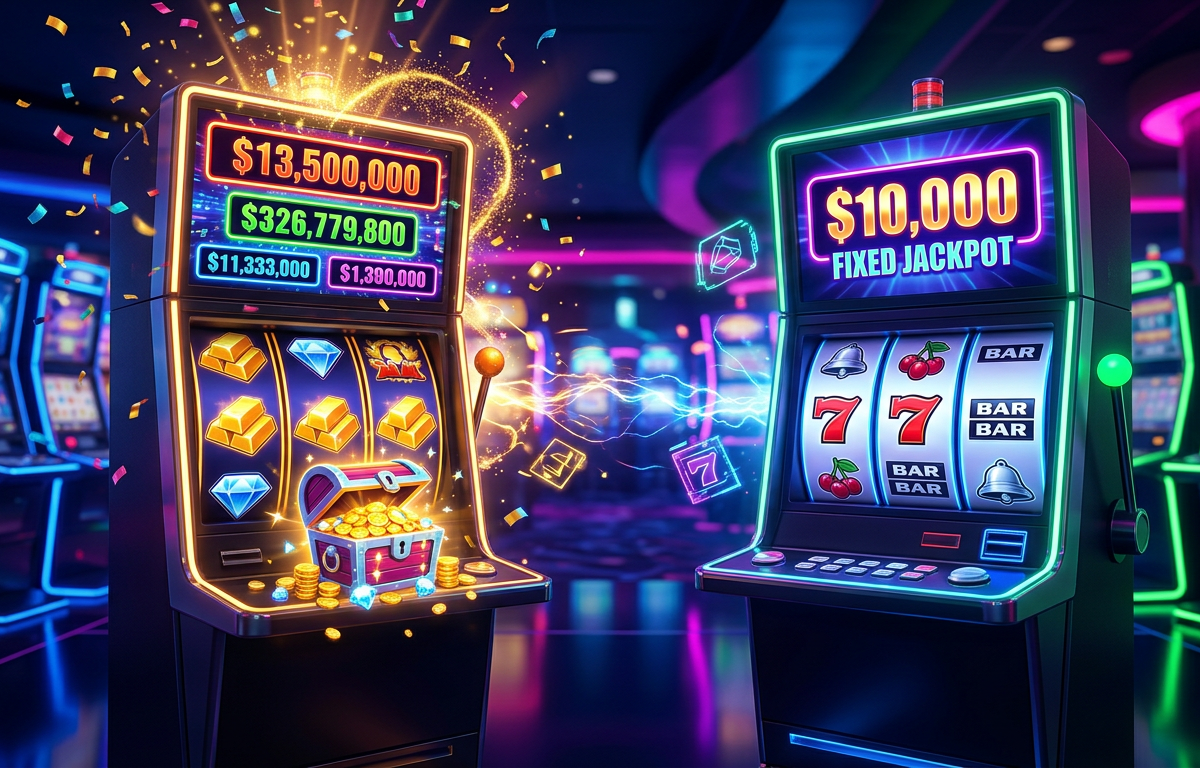
The allure of hitting a massive jackpot draws millions of players to slot machines worldwide. But not all jackpots are created equal, and understanding the fundamental differences between progressive and fixed jackpots can dramatically impact your gaming strategy and potential returns.
Both jackpot types offer unique advantages and drawbacks that appeal to different player preferences. Progressive jackpots promise life-changing sums but with astronomical odds, while fixed jackpots provide more predictable payouts with better winning chances.
Understanding Progressive Jackpots
Progressive jackpots continuously grow with each spin across a network of connected machines. Every time a player makes a bet on any linked slot, a small percentage contributes to the ever-increasing prize pool. This creates the potential for truly staggering payouts that can reach millions of dollars.
The most famous progressive jackpots include Mega Moolah, which holds the Guinness World Record for the largest online slot payout at €18.9 million. Other notable progressives like Mega Fortune and Hall of Gods regularly produce millionaires, with average jackpots ranging from $5 million to $15 million.
Progressive networks operate at different levels. Local progressives connect machines within a single casino, while area progressives link multiple venues in a region. Wide-area progressives, the largest category, connect thousands of machines across multiple states or countries, creating the biggest possible prize pools.
How Progressive Jackpots Accumulate
The accumulation rate depends on several factors. The contribution percentage typically ranges from 1% to 5% of each wager, while the number of linked machines and betting volume determine growth speed. Popular progressives can increase by thousands of dollars per hour during peak playing times.
Most progressive jackpots feature a "seed amount" - the minimum starting value after someone wins. Major progressives usually seed between $1 million and $10 million, ensuring the prize remains attractive even immediately after a payout.
Understanding Fixed Jackpots
Fixed jackpots offer predetermined maximum payouts that never change, regardless of play volume or time elapsed. These jackpots typically range from a few hundred dollars to several hundred thousand, providing more modest but achievable winning targets.
The fixed nature means every spin has identical odds of hitting the jackpot. Whether you play immediately after someone wins or after months without a payout, your chances remain constant. This predictability appeals to players who prefer known quantities over variables.
Fixed jackpots often integrate better with regular gameplay, frequently triggering during bonus rounds or special features. This creates more frequent smaller celebrations and maintains engagement without the extreme volatility of progressive systems.
Fixed Jackpot Variations
Multi-level fixed jackpots offer several tiers, such as Mini, Minor, Major, and Grand prizes. These systems provide multiple winning opportunities within a single game, with jackpots ranging from 10x to 10,000x your bet amount.
Some games feature mystery fixed jackpots that can trigger randomly on any spin, while others require specific symbol combinations or bonus achievements. The variety in triggering mechanisms adds strategic elements to gameplay.
Payout Frequency Analysis
The frequency of jackpot payouts differs dramatically between progressive and fixed systems. Fixed jackpots typically hit much more often, with major prizes occurring every few thousand to hundred thousand spins depending on the game design.
Progressive jackpots, particularly the largest ones, may go months or even years between payouts. Mega Moolah's major jackpot averages one winner every 8-12 weeks, while smaller progressives might pay out weekly or monthly.
Statistical analysis shows that fixed jackpots provide more consistent returns over shorter playing sessions. Players seeking regular excitement and smaller wins often find fixed systems more satisfying, as the wins come frequently enough to maintain interest.
Return to Player Considerations
Fixed jackpot games typically maintain consistent RTP rates between 94% and 98%. The predictable nature allows for more accurate mathematical modeling and fair distribution of returns across all prize levels.
Progressive games often have slightly lower base RTPs, usually ranging from 92% to 96%. However, the progressive contribution can push the theoretical RTP higher when the jackpot reaches extreme levels, sometimes exceeding 100% for brief periods.
For more insights, check out our guide on Transfer Window 2026 – The 10 Moves That Could Reshape European Football This Summer.
Value Comparison and Expected Returns
Calculating expected value requires understanding both payout amounts and winning probabilities. Fixed jackpots offer clearer calculations since all variables remain constant, making it easier to determine long-term expectations.
Progressive jackpots present more complex value propositions. While the potential payouts far exceed fixed alternatives, the odds are correspondingly worse. The expected value fluctuates constantly as the jackpot grows, creating optimal playing windows for mathematically-minded players.
Consider a fixed jackpot of $50,000 with 1 in 2 million odds versus a progressive starting at $1 million with 1 in 50 million odds. The fixed option provides better expected value until the progressive reaches approximately $2.5 million, at which point the progressive becomes mathematically superior.
Bankroll Impact Considerations
Progressive games often require maximum bets to qualify for the jackpot, significantly impacting bankroll longevity. A $5 max bet requirement means your money depletes five times faster than playing the same game at $1 per spin.
Fixed jackpots usually offer proportional payouts based on bet size, allowing players to chase jackpots at their comfort level. This flexibility makes fixed games more accessible to recreational players with limited budgets.
Risk vs Reward Analysis
The risk profiles of progressive and fixed jackpots cater to different player personalities. Progressive jackpots represent high-risk, high-reward scenarios where players accept poor odds for transformative payouts.
Fixed jackpots offer moderate risk with moderate rewards, appealing to players who prefer steadier gameplay with achievable goals. The psychological impact of winning $25,000 versus chasing an impossible $25 million affects player satisfaction differently.
Understanding volatility becomes crucial when comparing jackpot types. Low vs high volatility slots data shows clear patterns in how different variance levels affect session outcomes and player bankrolls.
Psychological Factors
The dream factor cannot be ignored in jackpot analysis. Progressive jackpots sell fantasies of instant wealth and life transformation, creating powerful emotional connections that override mathematical logic for many players.
Fixed jackpots provide more realistic goal-setting opportunities. Winning $10,000 feels achievable and motivating, while chasing $10 million can feel futile despite the mathematical possibility.
Strategic Considerations for Different Player Types
Casual players often benefit more from fixed jackpot games due to better odds and more frequent wins. The entertainment value per dollar spent typically exceeds progressive alternatives when playing with modest budgets.
High-roller players might find progressives more appealing, especially when jackpots reach historically high levels. The ability to make large bets increases both qualification chances and overall expected value during optimal periods.
Professional advantage players sometimes target progressive jackpots that exceed their breakeven points. These opportunities are rare but can provide positive expected value for those with sufficient bankrolls and risk tolerance.
Session Length and Budget Management
Fixed jackpots support longer playing sessions due to more frequent small wins that replenish bankrolls. The steady action maintains interest without the feast-or-famine nature of progressive play.
Progressive jackpot sessions tend to be shorter and more intense, with players either hitting early success or depleting bankrolls quickly while chasing the big prize. This dynamic requires careful budget planning and loss limits.
Similar strategic thinking applies to buy bonus slots versus standard bonus rounds, where players must weigh guaranteed features against natural triggering mechanisms.
Making the Right Choice for Your Playing Style
Choosing between progressive and fixed jackpots depends on your personal gambling goals, risk tolerance, and available bankroll. Players seeking entertainment value and modest wins should gravitate toward fixed jackpots with reasonable odds and frequent payouts.
Those dreaming of life-changing money and willing to accept extreme odds might prefer progressive systems, particularly when jackpots reach exceptional levels. Understanding that these are long-term negative expectation games remains crucial regardless of jackpot size.
Budget constraints play a major role in this decision. Fixed jackpots accommodate all budget levels, while progressive qualification requirements might force uncomfortable betting levels that accelerate losses.
Hybrid Approaches
Many experienced players employ hybrid strategies, playing fixed jackpots for regular entertainment and switching to progressives only when conditions are optimal. This approach balances the steady enjoyment of fixed games with occasional shots at life-changing money.
Setting aside specific portions of gambling budgets for each jackpot type helps maintain financial discipline while enjoying both experiences. This prevents the emotional pull of progressive jackpots from overwhelming sound bankroll management.
Frequently Asked Questions
Which jackpot type offers better odds of winning?
Fixed jackpots offer significantly better odds, typically ranging from 1 in 10,000 to 1 in 1 million depending on the prize amount. Progressive jackpots usually have odds between 1 in 10 million to 1 in 300 million for major prizes, making them much harder to hit but offering larger potential payouts.
Do progressive jackpots have worse RTP than fixed jackpot games?
Progressive games often have slightly lower base RTPs (92-96%) compared to fixed jackpot games (94-98%). However, when progressive jackpots grow very large, the total RTP including the jackpot contribution can temporarily exceed fixed game RTPs, sometimes even surpassing 100%.
Can you win progressive jackpots without betting the maximum amount?
Most progressive jackpots require maximum bet qualification, meaning you must bet the highest coin denomination and paylines to be eligible. Some newer progressive systems offer proportional jackpots based on bet size, but traditional major progressives typically require max bets for full jackpot eligibility.
How often do million-dollar progressive jackpots actually pay out?
Major progressive jackpots like Mega Moolah typically pay out every 8-12 weeks on average, though the timing varies significantly. Smaller network progressives might pay monthly or bi-monthly, while local casino progressives could hit several times per week depending on the prize pool and player volume.
Are fixed jackpots better for casual players with small budgets?
Yes, fixed jackpots are generally better suited for casual players because they don't require maximum bets, offer better winning odds, and provide more frequent smaller wins that help extend playing sessions. The entertainment value per dollar is typically higher with fixed jackpots for recreational players.
What happens to progressive jackpots when someone wins?
When someone wins a progressive jackpot, it resets to a predetermined "seed" amount, usually between $1 million and $10 million for major progressives. The jackpot then begins accumulating again from this seed amount, with contributions from every qualifying bet across the network continuing to build the prize pool.