
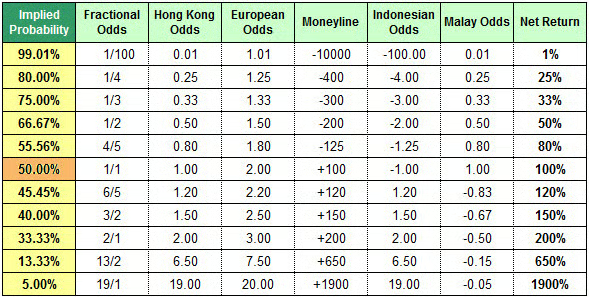
If you have ever looked at a sportsbook and felt confused by the numbers next to each selection, you are not alone. Betting odds can appear intimidating at first glance, especially when different platforms display them in completely different formats. However, once you understand the logic behind each system, reading odds becomes second nature — and more importantly, you will start to see what those numbers are really telling you about risk, probability, and potential return.
Betting odds serve two simultaneous purposes. First, they tell you how likely a bookmaker believes an outcome is to occur. Second, they tell you exactly how much you stand to win relative to what you have staked. Both functions are equally important, and understanding them together is what separates an informed bettor from someone who is simply guessing. Paired with a solid bankroll management strategy, this knowledge becomes the foundation of profitable betting.
There are three main formats used by sportsbooks around the world. Decimal odds are the dominant format in Europe, Australia, and Canada. Fractional odds are the traditional format in the United Kingdom and Ireland, still widely used in horse racing. American moneyline odds are the standard across US sportsbooks and are increasingly appearing on global platforms for major American sports. Each format carries identical underlying information — they are simply different ways of expressing the same mathematical relationship between probability and payout.
In this guide, we will walk through each format in detail, show you how to calculate your potential returns, explain how to convert between formats, and introduce the concept of implied probability — the most important tool any bettor can have in their arsenal.
What Are Betting Odds?
At their most fundamental level, betting odds are a numerical representation of probability. When a bookmaker prices a football match, they are not simply guessing — they are applying a sophisticated probability model that factors in team form, injuries, historical head-to-head records, home advantage, weather conditions, market sentiment, and dozens of other variables. The resulting odds reflect that model's output, translated into a format that also incorporates the bookmaker's profit margin.
This is a crucial point that many beginner bettors overlook. The odds displayed on a sportsbook are not a neutral reflection of true probability. They are the bookmaker's probability estimate with a margin baked in to ensure the house makes money over time regardless of outcomes. Understanding this distinction is the first step toward making smarter betting decisions.
It is also important to understand that odds fluctuate constantly. A match opening with a team priced at 2.50 can shift to 2.20 by kick-off as money flows into the market. These movements are informative in their own right — they reveal where the betting public and professional bettors are placing their money, and sometimes signal information that is not yet public knowledge.
Finally, different bookmakers will offer different odds on the same event. This is known as the "line" difference, and shopping for the best available odds on any selection — a practice called line shopping — is one of the simplest and most effective ways to improve your long-term returns without changing a single selection you make. For a practical example of how these formats appear in real markets, see our Premier League 2025/26 title race odds breakdown.
Decimal Odds Explained
Decimal odds are widely considered the most intuitive format for beginners and are the standard display format on most European sportsbooks. The number shown represents your total return for every one unit staked — and crucially, that total return includes your original stake. So when you see odds of 3.50, a £10 bet returns £35 in total: £25 profit plus your £10 stake back.
How to Calculate Your Return with Decimal Odds
The formula is straightforward. Total Return = Stake multiplied by Decimal Odds. Profit = Total Return minus your Stake. For example, if you stake £20 at odds of 4.00, your total return is £80 and your profit is £60.
Odds of exactly 1.0 would mean no profit at all — you would simply receive your stake back. In practice, you will never see odds this low at a legitimate bookmaker, as they would make no sense commercially. The theoretical threshold between favourite and underdog in decimal odds sits at 2.0, which represents an even-money bet: a profit equal to your stake. Anything below 2.0 is a favourite (the bookmaker believes it is more likely than not to happen), and anything above 2.0 is an underdog.
Decimal Odds Reference Table
| Decimal Odds | £10 Total Return | £10 Profit | Implied Probability |
|---|---|---|---|
| 1.25 | £12.50 | £2.50 | 80.0% |
| 1.50 | £15.00 | £5.00 | 66.7% |
| 2.00 | £20.00 | £10.00 | 50.0% |
| 3.00 | £30.00 | £20.00 | 33.3% |
| 5.00 | £50.00 | £40.00 | 20.0% |
| 10.00 | £100.00 | £90.00 | 10.0% |
| 20.00 | £200.00 | £190.00 | 5.0% |
One of the most useful aspects of decimal odds is how simple they make implied probability calculations. To find the implied probability of any decimal odds, simply divide 1 by the decimal number and multiply by 100. Odds of 4.00 imply a 25% probability (1 ÷ 4 × 100). Odds of 1.50 imply a 66.7% probability (1 ÷ 1.5 × 100). This calculation is at the heart of value betting, which we cover in detail below.
Fractional Odds Explained
Fractional odds have been used in British and Irish betting for well over a century and remain the dominant format in horse racing, greyhound racing, and many traditional UK sportsbooks. At first glance, they can seem less intuitive than decimal odds, but once you understand what the two numbers represent, reading them becomes equally straightforward.
The fraction describes the ratio of profit to stake. The number on the left (the numerator) is how much profit you stand to make. The number on the right (the denominator) is what you need to stake to make that profit. So odds of 5/1 mean you win £5 profit for every £1 you stake. Odds of 7/2 mean you win £7 profit for every £2 you stake.
How to Calculate Returns with Fractional Odds
Profit = (Numerator divided by Denominator) multiplied by your Stake. Total Return = Profit plus your Stake. So at odds of 5/1 with a £10 stake: Profit = (5 ÷ 1) × £10 = £50. Total Return = £50 + £10 = £60. At 7/2 with a £10 stake: Profit = (7 ÷ 2) × £10 = £35. Total Return = £35 + £10 = £45.
When the numerator is larger than the denominator — for example 3/1, 10/1, or 20/1 — the selection is an outsider that the bookmaker considers less likely to win than to lose. When the denominator is larger — for example 1/3 or 2/7 — the selection is a strong favourite. These are called "odds-on" prices, and they signal that your potential profit is less than your stake. Many casual bettors instinctively avoid odds-on selections because the reward seems small, but this thinking is misguided — an odds-on selection is not inherently a bad bet if the bookmaker's implied probability underestimates the true probability of the outcome.
"Evens" — written as 1/1 or simply EVS — is the fractional equivalent of decimal odds 2.0. At evens, your profit equals your stake exactly. A £10 bet at evens returns £20 in total: £10 profit plus your £10 stake back. It implies a 50% probability, like a coin flip.
Fractional Odds Reference Table
| Fractional Odds | £10 Profit | £10 Total Return | Decimal Equivalent | Implied Probability |
|---|---|---|---|---|
| 1/4 | £2.50 | £12.50 | 1.25 | 80.0% |
| 1/2 | £5.00 | £15.00 | 1.50 | 66.7% |
| 1/1 (Evens) | £10.00 | £20.00 | 2.00 | 50.0% |
| 6/4 | £15.00 | £25.00 | 2.50 | 40.0% |
| 2/1 | £20.00 | £30.00 | 3.00 | 33.3% |
| 7/1 | £70.00 | £80.00 | 8.00 | 12.5% |
| 20/1 | £200.00 | £210.00 | 21.00 | 4.8% |
American (Moneyline) Odds Explained
American odds, also called moneyline odds, are the standard format used across US sportsbooks and are expressed as three-digit numbers preceded by either a plus (+) or minus (−) sign. The sign is the key to reading them: a positive number always indicates an underdog, while a negative number always indicates a favourite. The magnitude of the number tells you how big an underdog or favourite the selection is.
Positive American Odds (+)
Positive odds tell you how much profit a stake of exactly $100 would generate. If you see +350, that means a $100 bet returns $350 in profit, plus your $100 stake back — a total payout of $450. You do not have to bet $100; the odds simply use that as their reference point. To calculate profit at any stake size, the formula is: Profit = (Odds ÷ 100) × Stake. For example, a $40 bet at +350 generates a profit of (350 ÷ 100) × $40 = $140.
Negative American Odds (−)
Negative odds tell you how much you need to stake in order to generate a profit of $100. If you see −200, you must bet $200 to win $100 profit. The bigger the negative number, the stronger the favourite. To calculate profit at any stake size, the formula is: Profit = (100 ÷ |Odds|) × Stake. So a $50 bet at −200 generates a profit of (100 ÷ 200) × $50 = $25.
American Odds Reference Table
| American Odds | $100 Profit | Decimal Equivalent | Implied Probability |
|---|---|---|---|
| −500 | $20.00 | 1.20 | 83.3% |
| −200 | $50.00 | 1.50 | 66.7% |
| −110 | $90.91 | 1.91 | 52.4% |
| +100 | $100.00 | 2.00 | 50.0% |
| +150 | $150.00 | 2.50 | 40.0% |
| +300 | $300.00 | 4.00 | 25.0% |
| +700 | $700.00 | 8.00 | 12.5% |
One oddity worth noting: odds of +100 and −100 both represent an even-money bet — a 50% implied probability — which is equivalent to decimal 2.0 or fractional 1/1. In practice, you will almost never see −100 displayed, as sportsbooks price even-money markets with a small favourite (e.g. −110) on both sides to build in their margin.
How to Convert Between Formats
Being able to convert between formats is an underrated but highly practical skill. If you compare odds across multiple bookmakers — which you should always do before placing a bet — you may encounter platforms using different formats. Converting everything to decimal first makes comparison fast and reliable.
Fractional to Decimal
Decimal = (Numerator ÷ Denominator) + 1. Example: 5/2 becomes (5 ÷ 2) + 1 = 3.50. Example: 9/4 becomes (9 ÷ 4) + 1 = 3.25.
American (+) to Decimal
Decimal = (American Odds ÷ 100) + 1. Example: +250 becomes (250 ÷ 100) + 1 = 3.50.
American (−) to Decimal
Decimal = (100 ÷ |American Odds|) + 1. Example: −200 becomes (100 ÷ 200) + 1 = 1.50.
Decimal to Fractional
Subtract 1 from the decimal odds, then express as a fraction. Example: 3.50 − 1 = 2.50, which as a fraction is 5/2. Example: 4.00 − 1 = 3.00, which as a fraction is 3/1.
Decimal to American (+)
Applicable when decimal odds are 2.0 or above: (Decimal − 1) × 100. Example: 3.50 becomes (3.50 − 1) × 100 = +250.
Decimal to American (−)
Applicable when decimal odds are below 2.0: −100 ÷ (Decimal − 1). Example: 1.50 becomes −100 ÷ (1.50 − 1) = −200.
Most reputable online sportsbooks allow you to toggle between odds formats directly in your account settings. If you are comfortable with decimal odds, switching every account to that format removes unnecessary mental arithmetic and makes cross-book comparisons instantaneous.
Implied Probability: What Odds Really Tell You
Implied probability is the single most important concept in sports betting beyond the odds themselves. It is the bookmaker's built-in assessment of how likely an outcome is to occur, translated from the odds into a simple percentage. Every set of odds carries an implied probability whether or not it is displayed — it is always present, and every serious bettor should be calculating it automatically.
Here is why it matters. When you look at a set of odds, you are not just seeing a potential payout — you are seeing a claim about probability. The bookmaker is saying: "We believe this outcome has approximately this percentage chance of occurring." Your job, if you want to bet profitably over the long run, is to evaluate whether you agree with that assessment. If the implied probability underestimates the true probability in your view, you have found a value bet.
Calculating Implied Probability
From Decimal: IP = (1 ÷ Decimal Odds) × 100. From Fractional: IP = Denominator ÷ (Numerator + Denominator) × 100. From American (+): IP = 100 ÷ (Odds + 100) × 100. From American (−): IP = |Odds| ÷ (|Odds| + 100) × 100.
For example, if a team is priced at decimal odds of 3.20, the implied probability is (1 ÷ 3.20) × 100 = 31.25%. The bookmaker is saying this team has roughly a 31% chance of winning. If your own analysis leads you to believe the team has a 40% chance of winning, the odds represent exceptional value — the bookmaker has underpriced the selection relative to your assessed probability. This discrepancy, consistently identified and acted upon, is the foundation of profitable sports betting.
The Overround: How Bookmakers Make Money
In a perfectly fair market, the implied probabilities of all possible outcomes in an event would add up to exactly 100%. If a coin flip were offered as a betting market, each side would be priced at decimal 2.0 (50% implied probability) and together they would sum to 100%. This does not happen in practice. Bookmakers always ensure that the sum of implied probabilities across a market exceeds 100% — and that excess is their profit margin, known as the overround, the vig, or the juice.
Here is a real-world example. Suppose a Premier League match is priced as follows: Home Win at 2.10 (implied probability 47.6%), Draw at 3.40 (implied probability 29.4%), Away Win at 3.80 (implied probability 26.3%). Adding those together: 47.6 + 29.4 + 26.3 = 103.3%. That 3.3% surplus is the bookmaker's margin — their theoretical profit on every pound staked across this market.
The overround varies significantly between bookmakers and between market types. Mainstream football match markets at competitive sportsbooks typically carry an overround of 3–5%. Niche markets, novelty bets, or outright competition markets can carry margins of 8–15% or higher. Betting exchanges, where bettors wager against each other rather than against the house, typically charge a commission of 2–5% on winnings only — making them significantly lower-margin environments for consistent bettors.
Understanding the overround shapes how you should approach the market. When comparing prices across different bookmakers, always look for the highest available odds — a selection priced at 3.40 at one book versus 3.20 at another represents a meaningful difference in long-run profitability, even though the raw difference looks small.
What Is Value Betting?
Value betting is the practice of identifying selections where the bookmaker's implied probability understates the true probability of an outcome. It is the conceptual foundation of professional sports betting and the only approach with a demonstrable positive expected value over the long run.
A bet has positive expected value when: your assessed probability × the decimal odds is greater than 1.0. For example, if you believe a team has a 45% chance of winning and the decimal odds are 2.50 (implying 40%), then: 0.45 × 2.50 = 1.125. The result is above 1.0, confirming positive expected value. Over a large sample of similar bets, this edge should translate into profit — assuming your probability assessment is accurate.
Value betting does not mean picking winners more often than losers. A bettor can be wrong more than half the time and still be profitable, provided they consistently bet at odds that exceed the true probability. This is a counterintuitive but fundamental truth about sports betting that separates systematic bettors from casual punters who chase wins without regard for the price they are accepting.
Which Odds Format Should You Use?
There is no objectively superior format for every bettor — the best format is the one you understand most intuitively. That said, decimal odds offer practical advantages that make them the preferred choice for most analytical bettors. Implied probability calculations are simpler, total return calculations are faster, and cross-market comparisons are easier when everything is expressed in the same decimal format.
If you primarily bet on horse racing in the UK, fractional odds are unavoidable — they appear on racecards, on-course boards, and in the racing press. Developing fluency in both fractional and decimal simultaneously is worth the investment of time. If you regularly use US-facing sportsbooks for NFL, NBA, or MLB markets, American odds will be your constant companion and are worth mastering on their own terms rather than always converting.
The underlying recommendation is this: pick one format as your primary reference point for all probability and value assessments, and develop the ability to convert any format into that reference quickly. Consistency in how you process odds reduces the chance of miscalculation and keeps your decision-making process clean.
Common Mistakes When Reading Odds
Many new bettors confuse shorter odds with "safe" bets. While lower odds do indicate a higher implied probability, they are not inherently safer — a heavily favoured team can and does lose, and at short odds, a single loss can wipe out multiple winning returns. The price at which you back something matters just as much as your confidence in the outcome.
Another common error is ignoring the overround entirely and treating bookmaker odds as if they represent neutral probability. Every set of odds is inflated by the bookmaker's margin. When you see odds of 1.90 on both sides of a market, neither side represents a 50% probability — each represents approximately a 52.6% probability claim, with the combined overround sitting at around 5.3%.
Failing to shop for the best odds is one of the most costly and easily avoidable mistakes a bettor can make. If you consistently accept the first odds you see rather than checking multiple books, you are voluntarily giving away return over every bet you place. Maintaining accounts at three or more reputable sportsbooks and always placing your bet at the best available price is a simple habit that meaningfully improves long-run profitability without requiring any change to your selection process.
Frequently Asked Questions
What do odds of 2.00 mean?
Odds of 2.00 in decimal format (equivalent to 1/1 in fractional and +100 in American) mean that for every £1 you stake, you receive £1 profit plus your £1 stake back — a total return of £2. The implied probability is exactly 50%, like a coin flip.
Are lower odds always safer bets?
No. Lower odds indicate a higher implied probability, but they are not inherently safer. Heavy favourites lose regularly. More importantly, a low-odds bet can be poor value if the bookmaker has overestimated the favourite's probability. The price you accept relative to the true probability is what determines long-run profitability — not the absolute level of the odds.
What is the overround in betting?
The overround is the bookmaker's built-in profit margin. It is the amount by which the sum of implied probabilities across all outcomes in a market exceeds 100%. A football match with a 3.3% overround means the bookmaker has a theoretical 3.3% edge on every pound staked across that market, regardless of which outcome occurs.
Can I switch between odds formats on sportsbooks?
Yes. Almost all major online sportsbooks allow you to change your preferred odds display format in account settings. You can typically choose between decimal, fractional, and American at any time. Switching to your preferred format across all accounts makes odds comparison consistent and reduces calculation errors.
What is the difference between odds and probability?
Probability is a pure measure of likelihood expressed as a percentage between 0% and 100%. Odds are a way of expressing that likelihood tied to a specific payout structure. Any set of odds implies an underlying probability, which you can calculate directly. Because of the overround, bookmaker odds always imply a total probability above 100% across a complete market.
Why do odds change between when I look and when I bet?
Odds move in response to betting volume, new information (such as injury news or team announcements), and movements at other bookmakers. When significant money comes in on one side of a market, bookmakers shorten those odds to manage their liability and lengthen the odds on the other side. This is why checking odds close to the time of your intended bet is always advisable.