
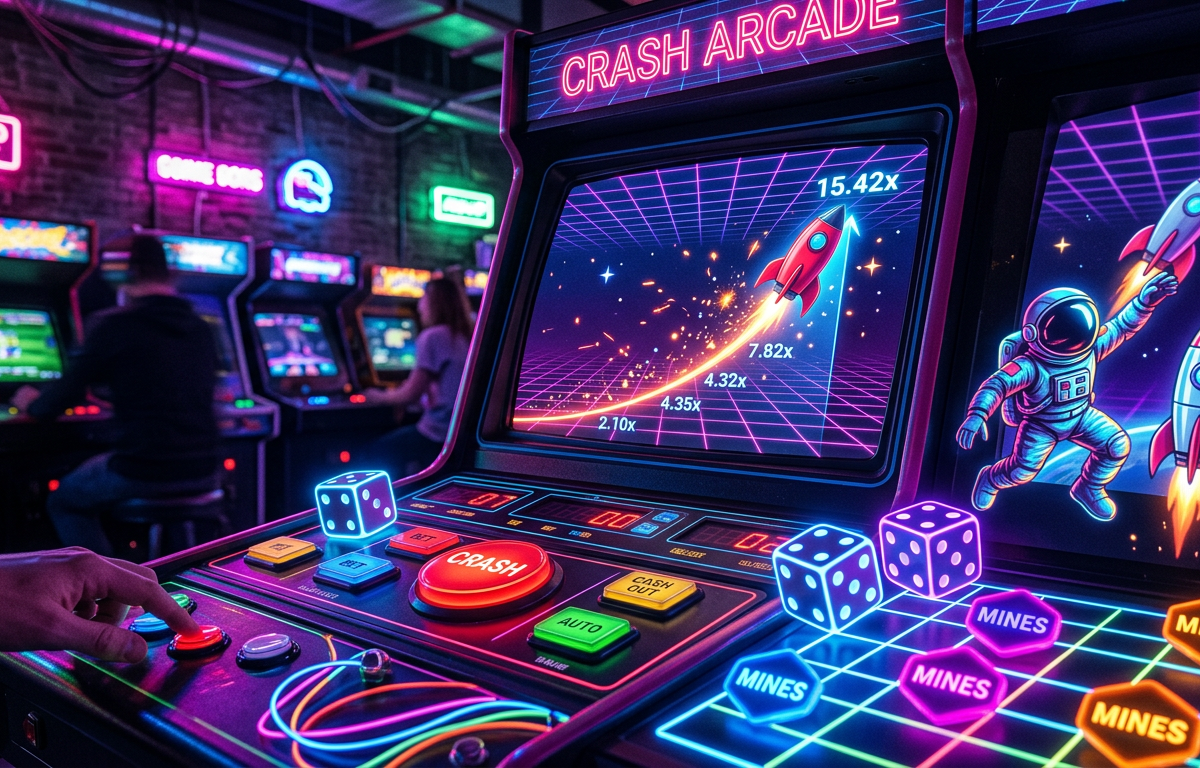
Crash games have revolutionized online gambling with their simple yet addictive gameplay. Players watch multipliers climb skyward while deciding when to cash out before the inevitable crash. But what actually happens behind the scenes in games like Aviator, Spaceman, and JetX?
Understanding the mechanics of these games goes beyond basic gameplay. The technology powering crash games involves sophisticated random number generation, provably fair algorithms, and carefully calibrated house edges that create the thrilling experience millions of players enjoy daily.
The Core Mechanics of Crash Games

Every crash game operates on a fundamental principle: a multiplier starts at 1x and increases over time until it suddenly crashes to zero. Players must cash out before the crash occurs to secure their winnings. This simple concept masks complex mathematical systems working behind the scenes.
The crash point is predetermined before each round begins using cryptographic algorithms. This ensures fairness and prevents manipulation by either players or operators. The system generates a random seed that determines exactly when the multiplier will crash, creating genuine unpredictability.
Most crash games refresh their rounds every 10-30 seconds, maintaining rapid gameplay that keeps players engaged. This quick turnover rate is part of what makes crash games particularly appealing to Gen Z players who prefer short, intense gaming sessions.
Aviator: The Pioneer's Algorithm
Aviator, developed by Spribe, uses a provably fair system based on cryptographic hashing. Each round's outcome is determined by combining server seeds, client seeds, and nonces (numbers used once) to create an unpredictable result that can be verified by players.
The game's algorithm calculates crash points using the formula: crash_point = (2^32 / (2^32 - hash)) * (1 - house_edge). This mathematical approach ensures that over time, the house maintains its edge while providing fair individual rounds.
Aviator's multiplier increases at varying rates, sometimes climbing slowly to high values like 50x or 100x, other times crashing almost immediately. The average crash point hovers around 2x, but the distribution creates the excitement that defines the game.
Statistical analysis shows that Aviator crashes before 2x approximately 50% of the time, with crashes occurring before 1.5x about 37% of rounds. These percentages remain consistent across millions of games, demonstrating the algorithm's reliability.
Aviator's Unique Features
Unlike many crash games, Aviator displays other players' bets and cash-out points in real-time. This social element adds psychological pressure and community engagement. The game also includes chat functionality and bet history, creating a more immersive experience.
The auto-cash-out feature allows players to set predetermined exit points, removing emotional decision-making from the equation. However, manual cash-outs often provide more excitement and potential for higher multipliers.
Spaceman: The Evolution of Crash Gaming
Pragmatic Play's Spaceman introduces several innovations while maintaining the core crash game mechanics. The game uses a certified random number generator (RNG) that's regularly tested by independent auditing firms to ensure fairness.
Spaceman's algorithm incorporates a more dynamic multiplier progression system. The astronaut's journey through space represents the multiplier climb, with visual cues that heighten tension without revealing the predetermined crash point.
The game features a house edge of approximately 3-4%, slightly higher than some competitors but still competitive within the crash game market. This edge is built into the mathematical model that determines crash frequencies and multiplier distributions.
One distinctive aspect of Spaceman is its "50% cashout" feature, allowing players to secure half their winnings while letting the remainder ride. This risk management tool provides more strategic options compared to traditional all-or-nothing crash games.
Spaceman's Technical Specifications
The game operates on HTML5 technology, ensuring smooth performance across desktop and mobile devices. Server response times average under 50 milliseconds, crucial for maintaining fair play when players attempt to cash out at precise moments.
Spaceman's RNG system generates outcomes using atmospheric noise and other entropy sources, creating true randomness rather than pseudo-randomness. This approach strengthens player confidence in the game's fairness.
JetX: Advanced Mechanics and Features
SmartSoft Gaming's JetX pushes crash game innovation further with dual betting options and enhanced visual presentation. Players can place two simultaneous bets with different strategies, adding complexity to the basic crash game formula.
JetX uses a blockchain-based provably fair system that allows complete verification of each round's integrity. The smart contract governing the game is publicly accessible, providing unprecedented transparency in crash game mechanics.
The game's algorithm adjusts multiplier acceleration based on recent crash patterns, creating more varied gameplay experiences. While the overall house edge remains constant, individual sessions feel more dynamic and unpredictable.
Statistical data from JetX shows crash distributions that favor lower multipliers while still providing occasional high-value outcomes. Approximately 63% of rounds crash before 2x, while crashes above 10x occur roughly 1% of the time.
JetX's Innovative Elements
The jet's flight path includes turbulence effects that create visual drama without affecting the predetermined outcome. These graphics serve purely aesthetic purposes but significantly enhance player engagement and excitement.
JetX's dual betting system allows risk diversification strategies. Players might cash out one bet early while letting the second ride for potential higher multipliers, creating more sophisticated gameplay approaches.
Random Number Generation and Fair Play
All reputable crash games rely on cryptographically secure random number generators to determine outcomes. These systems use complex mathematical algorithms that produce unpredictable results while maintaining statistical consistency over large sample sizes.
Provably fair technology allows players to verify each round's authenticity using public verification tools. Before each game begins, the operator publishes a hash of the outcome, proving they cannot manipulate results after players place bets.
Third-party auditing firms like eCOGRA and iTech Labs regularly test crash game RNG systems to ensure compliance with gambling regulations. These audits verify that stated return-to-player percentages match actual game performance.
The mathematical models governing crash games undergo rigorous testing to confirm they produce the expected distributions of outcomes. Any deviation from theoretical probabilities would indicate potential system flaws or manipulation.
House Edge and Return to Player Calculations
Crash games typically feature house edges between 1% and 5%, depending on the specific title and operator. This edge is built into the mathematical model that determines crash point frequencies and multiplier distributions.
For more insights, check out our guide on Mobile Casino Traffic Hits 70%+ Globally – How This Shift Is Redesigning Game Interfaces.
The return-to-player (RTP) percentage represents the theoretical amount returned to players over infinite gameplay. Most crash games offer RTPs between 95% and 99%, competitive with traditional casino games.
House edges in crash games are transparent and verifiable, unlike some casino games where edge calculations require complex analysis. Players can easily understand that a 3% house edge means the casino retains 3% of all wagers over time.
Variance in crash games tends to be high, meaning individual sessions can deviate significantly from theoretical expectations. This volatility creates the excitement that attracts players while ensuring long-term profitability for operators.
The Psychology Behind Crash Game Mechanics
Crash games exploit several psychological principles that make them particularly engaging. The tension of watching multipliers climb creates adrenaline responses similar to extreme sports or high-stakes situations.
Variable ratio reinforcement schedules, where rewards arrive unpredictably, are among the most powerful behavioral conditioning tools. Crash games naturally implement this schedule, creating strong engagement patterns.
The illusion of control plays a significant role in player psychology. While outcomes are predetermined, the ability to choose when to cash out makes players feel they're influencing results through skill rather than luck.
Near-miss experiences, where crashes occur shortly after players cash out, trigger dopamine responses that encourage continued play. These events feel like "almost winning" even when players actually secured profits.
Technical Infrastructure and Server Architecture
Crash games require robust server infrastructure to handle simultaneous players and ensure fair timing for cash-out attempts. Modern implementations use cloud-based architectures with global content delivery networks.
Latency optimization is crucial since milliseconds can determine whether a cash-out succeeds or fails. Game servers typically maintain sub-100-millisecond response times to ensure fair play across different geographic locations.
Database systems storing game outcomes must be tamper-proof and instantly accessible for verification purposes. Blockchain technology increasingly provides this infrastructure, offering immutable records of all game events.
Load balancing systems distribute players across multiple servers to maintain consistent performance during peak hours. Popular crash games can handle thousands of simultaneous players without degrading response times.
Frequently Asked Questions
How do crash games determine when to crash?
Crash games use random number generators and cryptographic algorithms to predetermine crash points before each round begins. The exact moment is calculated using mathematical formulas that ensure fairness while maintaining the house edge. Players cannot predict or influence when crashes will occur.
Are crash games rigged or can they be manipulated?
Reputable crash games use provably fair systems that prevent manipulation by operators or players. These systems allow verification of each round's integrity using cryptographic verification tools. Regular audits by independent testing agencies ensure compliance with fairness standards.
What's the house edge in popular crash games like Aviator?
Most crash games feature house edges between 1% and 5%. Aviator typically maintains around 3% house edge, while Spaceman and JetX have similar ranges. This edge is transparently built into the mathematical models governing crash point distributions.
Can auto-cash-out features improve winning chances?
Auto-cash-out features don't improve mathematical odds but can help manage risk and remove emotional decision-making. Setting consistent cash-out points creates more predictable outcomes compared to manual decisions influenced by excitement or fear.
Why do crash games appeal specifically to younger players?
Crash games feature fast-paced action with rounds lasting 10-30 seconds, matching younger players' preferences for quick entertainment. The simple mechanics, social features, and mobile optimization align with digital-native gaming habits and shorter attention spans.
How can I verify if a crash game is fair?
Look for provably fair certification and use the verification tools provided by the game operator. Check for third-party audit certificates from agencies like eCOGRA or iTech Labs. Reputable operators publish their RNG testing results and provide hash verification systems for player use.